Home
Technology
Pipeline
Services
About
News
Contact

Neubacher, S., Saya, J.M., Amore, A., & Grossmann, T.N. J. Org. Chem. 2020, 85, 1476–1483. DOI: 10.1021/acs.joc.9b02490
In this paper a crosslinker library was presented and tested. The obtained screening results give a predictive framework for selecting optimal crosslinkers for a protein of interest and demonstrates the versatility and tunability of the platform.
The study reports the design and synthesis of nine distinct tris-electrophilic crosslinkers from three core structures (triethylamine-derived Ae, triazinane-derived Ta, benzene-derived Bz) combined with three electrophilic moieties (acrylamide, chloroacetamide, vinyl sulfonamide). This library spans a broad range of hydrophobicity (miLogP from −4.87 to +1.14) and flexibility (8–14 rotatable bonds). All nine crosslinkers were applied to the KIX domain (K1) and resulting INCYPRO protein variants showed substantially increased melting temperatures (Tm = 78–88°C vs. 59°C for linear K1). The most stable variant, K1-Ae2, achieved Tm = 88°C, a remarkable +29°C increase in melting temperature. Moreover, CD spectroscopy confirmed that cross-linking does not alter the overall protein fold. The most striking finding is a strong negative correlation (ρ = −0.87) between cross-link lipophilicity (miLogP) and thermal stability (Tm), application of the more hydrophilic crosslinkers resulted in more stable proteins. This observation provides a rational design rule for future INCYPRO applications.
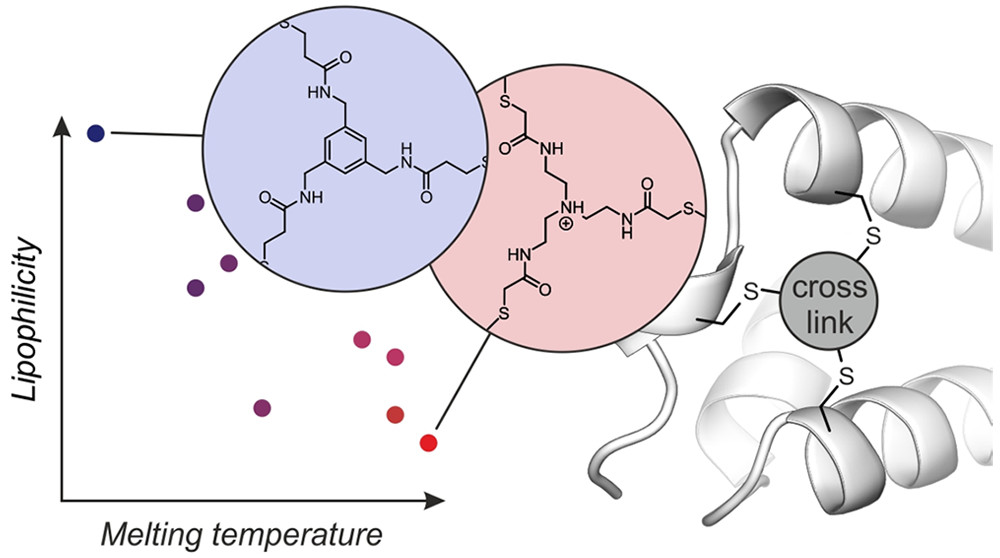
All nine obtained cross-linked protein versions show considerably increased thermal stability when compared to that of the linear precursor. Most interestingly, the degree of stabilization correlates with the hydrophilicity of the cross-link.