Home
Technology
Pipeline
Services
About
News
Contact

Hutchins, G.H., Kiehstaller, S., Poc, P., Lewis, A.H., Oh, J., Sadighi, R., Pearce, N.M., Ibrahim, M., Drienovská, I., Rijs, A.M., Neubacher, S., Hennig, S., & Grossmann, T.N. Chem 10, 615–627 (2024). DOI: 10.1016/j.chempr.2023.10.003
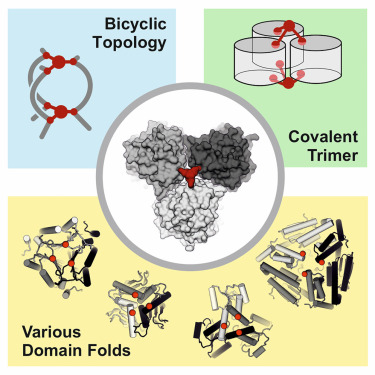
This paper demonstrates that INCYPRO is not limited to single-domain proteins but can stabilize multi-subunit complexes. Notably, this not only resulted in increased thermal and chemical stability, but also to improved aggregation behavior and prolonged shelf life.
Homotrimeric Pseudomonas fluorescens esterase (PFE) was used as model system and three covalent trimer topologies produced: star-shaped (p2₃Ta), branched (p3₃Ta), and bicyclic (p4₃Ta₂). The bicyclic variant, formed through bis-cross-linking, showed the greatest compactness and stability. It showed a ΔTm of +8.4°C and remained enzymatically active in up to 2M GuHCl, whereas unmodified PFE ceased activity above 1M.
Beyond thermal and chemical stability, the bicyclic trimer displayed a markedly reduced aggregation propensity. This is critically important for therapeutic and industrial proteins, where aggregation is a major cause of product loss during storage and use. The paper reports greatly prolonged shelf life for the bicyclized complexes, a key parameter for both manufacturing and clinical deployment. Beyond PFE, the approach was successfully applied to four additional structurally diverse trimeric protein complexes, confirming broad applicability.