Home
Technology
Pipeline
Services
About
News
Contact

Haim, A., Liebscher, S., Klintrot, R., Vallino, L., Masman, M., Simon, A.H., Hahn, M., Hennig, S., Neubacher, S., Bordusa, F., & Grossmann, T.N. Angew. Chem. Int. Ed. 2026, e21611. DOI: 10.1002/anie.202521611
This paper is a landmark publication as it demonstrates INCYPRO on a new enzyme class, D-stereospecific hydrolases, and shows that the technology can create novel protein architectures with enhanced activity, not just stability. Moreover, the publication proves that multiple INCYPRO modifications can be stacked additively. The 42-fold activity increase and the >400-fold half-life extension under stress conditions (10% ethanol at 50°C) are the most dramatic performance metrics reported for any INCYPRO variant to date.
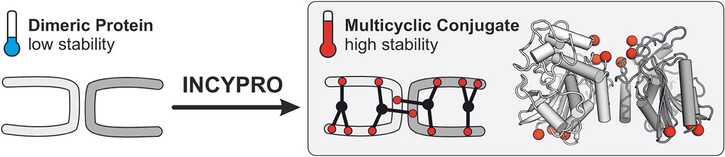
Here, INCYPRO was applied to DHy1, a D-stereospecific hydrolase from Bacillus thuringiensis that cleaves after D-lysine and D-arginine. Wild-type DHy1 (wt-h) has low thermal stability (Tm = 49.5°C) and high sensitivity to organic cosolvents, limiting its industrial and diagnostic utility. Five triple-cysteine INCYPRO variants (h1–h5) were designed based on the crystal structure (PDB 9spl), and cross-linking with the iodoacetamide-based triselectrophile TaI₃ produced stabilized variants. Unexpectedly, the formation of a covalently cross-linked dimer (h4₂Ta₂) was observed upon INCYPRO treatment. The dimer h4₂Ta₂ showed higher thermal stability (Tm = 57.2°C, ΔTm = +7.8°C) than the monomer h4Ta (Tm = 52.6°C), and crucially displayed enhanced enzymatic activity even when compared to the wt (10.3 mkatal/mol vs. 7.4 mkatal/mol for h4Ta and 9.8 for wt-h). The structure of the dimer was confirmed via X-ray crystallography (PDB 9s7k). The combination of INCYPRO sites h2 and h4, that are located on opposite sides of the enzyme, in variant h6, creates a double-crosslinked enzyme. The monomeric h6Ta₂ (Tm = 60.6°C, ΔTm = +11.1°C) and dimeric h6₂Ta₄ (Tm = 65.8°C, ΔTm = +16.3°C) represent the most stable variants in the study. The dimeric h6₂Ta₄ achieved the highest enzymatic activity of all tested variants at 60°C (47.1 mkatal/mol) and dramatically outperformed wt-h in the presence of all tested organic cosolvents. Most impressively, in 10% ethanol at 50°C, h6₂Ta₄ displayed 42-fold higher enzymatic activity than wt-h while maintaining complete D-stereospecificity (ee > 99%). The half-life of h6₂Ta₄ under these conditions was 36 hours, compared to less than 5 minutes for wt-h — a more than 400-fold improvement.
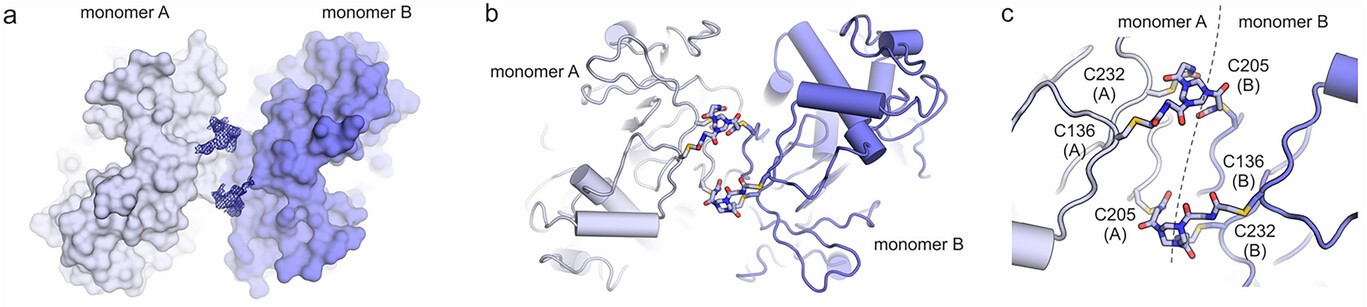
Crystal structure of dimeric h42Ta2 (PDB ID 9s7k): (a) Top: h42Ta2 dimer in surface representation. (mesh: electron density map 2mFo–DFc). (b) h42Ta2 dimer in cartoon representation with cross-links shown as sticks. (c) Zoom-in on the two cross-links.