Home
Technology
Pipeline
Services
About
News
Contact

Kiehstaller, S., Hutchins, G.H., Amore, A., Gerber, A., Ibrahim, M., Hennig, S., Neubacher, S., & Grossmann, T.N. Bioconjugate Chem. 2023, 34, 1114–1121. DOI: 10.1021/acs.bioconjchem.3c00151
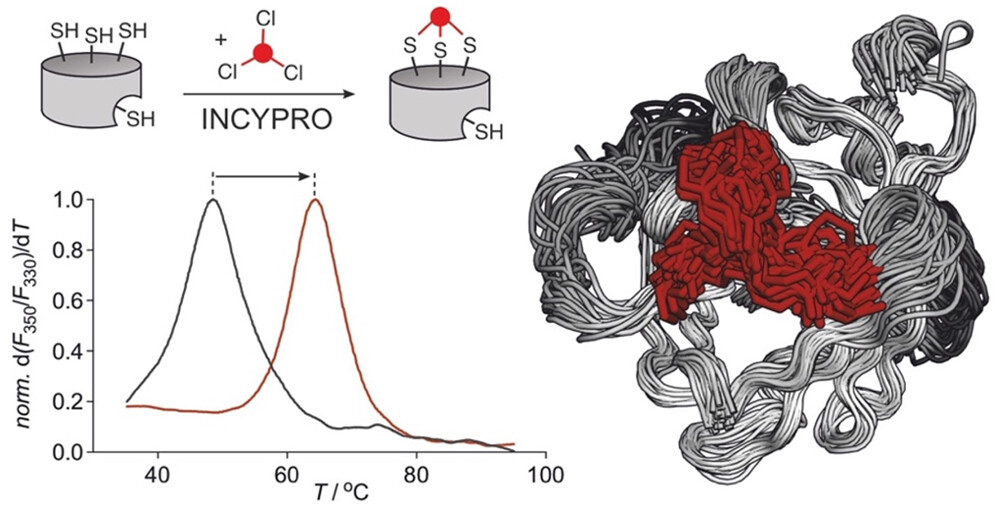
Many engineered enzymes with improved activity lack sufficient stability. Here, INCYPRO was used to restore and even enhance stability of Sortase A (SrtA) yielding improved INCYPRO xS11. SrtA is a transpeptidase, that plays a key role in anchoring surface proteins to the cell wall of Gram-positive bacteria. It is widely used in biotechnology for protein engineering, such as site-specific protein labeling, cyclization, and conjugation. Moreover, a purification strategy was developed that takes advantage of INCYPRO xS11 superior stability under denaturing conditions. The 8M variant of Sortase A has eight mutations that boost catalytic activity but reduce thermal stability (Tm = 52.4°C vs. 62.8°C for wild-type). INCYPRO cross-linking of the 8M derived triple-cysteine S11 variant yielded xS11. xS11 exceeded wild-type stability with a Tm = 64.3°C, a ΔTm of +11.9°C relative to 8M, while retaining meaningful transpeptidation activity under conditions that completely inactivate both wild-type SrtA and the 8M variant. In 3M urea, xS11 retains 41% of its initial activity while 8M is negligible. In 1M guanidine hydrochloride, xS11 retains 20% activity vs. < 1% for 8M. This expands available application spaces of Sortase A-based bioconjugation.